Activity 3: Business Environments
Business Studies Grade 11
Activity Purpose
To engage learners in inquiry-based knowledge construction where they analyse a real-world business case study, classify challenges by business environment (micro, market, macro), and collaboratively build a Business Rescue Plan.
Learner Engagement
Learners analyse the Ubuntu Bites (Pty) Ltd case study, categorise business challenges by environment type, evaluate their impact, and collaboratively construct a rescue plan using a digital whiteboard.
Teacher Role
The teacher introduces the case study, explains the three business environments, guides classification discussions, provides scaffolding questions, and facilitates the presentation of rescue plans.
Digital Tools
Microsoft Whiteboard, Miro, or Padlet (collaborative construction platforms)
Activity Brief
Case Study: Ubuntu Bites (Pty) Ltd , A South African food business facing multiple challenges across its micro, market, and macro environments.
Learners work through the following process:
- Analyse: Read and discuss the Ubuntu Bites case study, identifying all business challenges mentioned
- Classify: Categorise each challenge according to its business environment:
- Micro environment: Internal factors (management, employees, resources)
- Market environment: Industry-level factors (competitors, suppliers, customers)
- Macro environment: External factors (economic, political, technological, social)
- Evaluate: Assess the severity and interconnection of challenges
- Construct: Build a comprehensive Business Rescue Plan using the digital whiteboard
- Present: Share the rescue plan with the class for peer evaluation
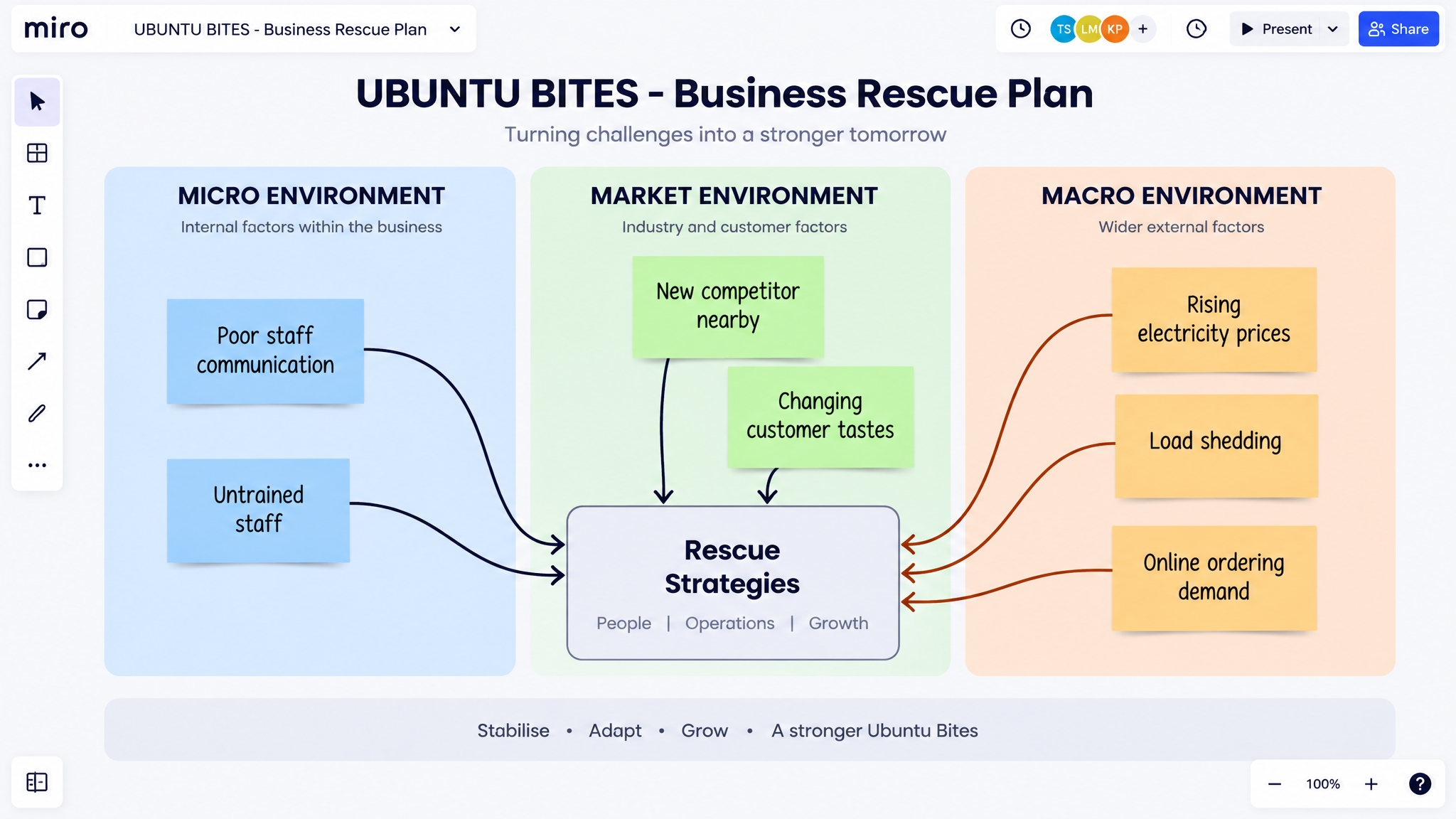
Example of Learner Work
An illustration of how the completed activity looks using the digital Mind Tool.
MindTool Characteristics
How this activity demonstrates the three defining features of cognitive tools.
Representation
The digital whiteboard represents knowledge through categories, links, and diagrams. Challenges are visually organised by environment type, making the structure of business environments concrete and explorable.
Distributed Cognition
Learning is shared across group members, the teacher's scaffolding, and the digital platform. Each participant contributes knowledge, and the platform preserves and organises the collective understanding.
Interactivity
Learners actively move, comment, rank, and reorganise elements on the digital whiteboard. They can reclassify challenges, adjust priorities, and iteratively refine their rescue plan.